Reframing Time in Climate and Health: The Case for Slowing Down
- Posted on: 26 November 2026
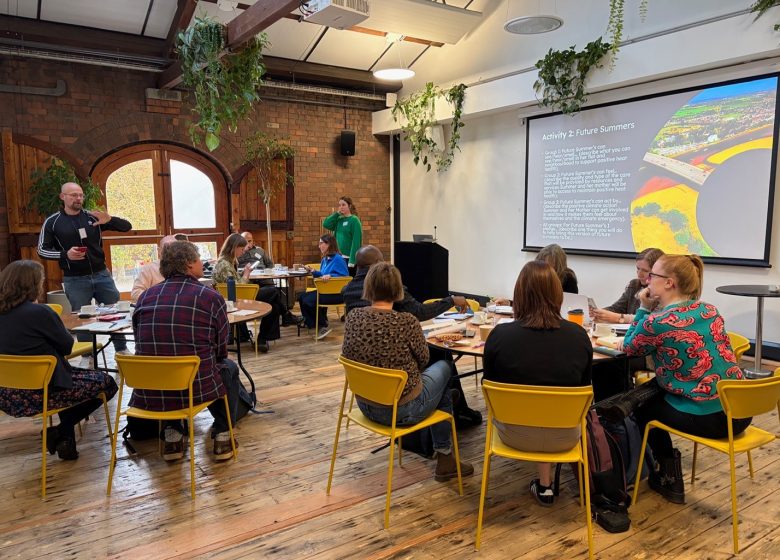
In early November 2026, 17 Taskforce members (including four of the Net+ team) met for an all-day in-person workshop at the Watershed in Bristol. We took a step back from day-to-day practice to ask: how is time framed in the stories we tell about climate and health, and what do those framings make possible?
We often talk about the urgency of climate change in terms of countdowns, future deadlines and emergencies. These framings spur action – but they can also limit who is heard, and who these narratives reach. The workshop invited Taskforce members to examine these assumptions and consider more effective, equitable framings.
We explored this through a series of themed discussions, which firstly involved reflections on past experiences and perspectives, to imagine future ideas for more effective, equitable frames of time. Topics of discussion included how climate-health emergencies are framed, the role of institutions, equitable narratives on adaptation, lived experiences of recent heatwaves, ideas for ‘future summers’, and ideas for Taskforce outputs. Participants shared personal and professional reflections on the opportunities and challenges of reframing climate change as a health issue through the Taskforce and beyond.
Why Time Matters
Time is a crucial theme in climate-health conversations today. Climate communicators must anticipate unknown futures, express gradual impacts, and make sense of the tangled social and ecological factors that shape health. Many Taskforce participants also work in political settings where ‘climate’ conversations meet resistance, so need to find novel frames to bridge divides. This is a pertinent issue we will keep exploring throughout the Taskforce.
Our discussion built on a literature review of time and climate framings. This takes a ‘plural’ view of time, moving beyond linear storylines that dominate climate debates, to incorporate lived, social and ecological aspects of time. This drew on critical climate and health scholarship on the need to reframe pace in crisis narratives, making the case for ‘slower’ frames that take a ‘long and ecological view’ (Lancaster and Rhodes, 2023) of climate-health harms and responses. This can incorporate the cumulative histories producing uneven climate impacts on health. It can also counter reliance on future ‘silver-bullet’ technological solutions, which can often inform ‘discourses of delay’ that help to justify inaction.
The Value of Slower Frames
A ‘slower’ lens can also reveal existing forms of adaptation that are taken for granted, such as forms of cross-sector collaboration or mutual support within communities. For example, we discussed ‘slow’ trust-building, the ‘deep work’ of long-term community engagement, and the crucial role of volunteers in the community sector. Not to mention the care and commitment of stakeholders engaging in climate-health communities of practice like the Taskforce itself. For equitable and effective community engagement, people working in climate-health sectors often put in additional time to sustain relationships beyond the timeframes project funding, working to fill the gaps. These efforts are crucial yet often unrecognised in metrics-driven evaluation.
What’s next
This discussion could therefore inform recommendations to funders, researchers and decision-makers on the need to broaden frames of climate-health work to support the complex relational work required to sustain it. This also feeds into our next discussion on evidence – and what counts as evidence – for decision-making.
We are grateful to everyone who took part and look forward to building on these ideas. You can follow this work on the Taskforce webpage.